
Everything you need to know about agriculture analytics
Global agriculture is undergoing a seismic shift. Climate uncertainty, rising operational costs, labor shortages, supply-chain pressures, and the growing demand for sustainable food systems are pushing the industry toward digital transformation. At the center of this change is agriculture analytics—the practice of using data, predictive models, AI, IoT sensors, geospatial tools, and cloud platforms to turn raw farm data into actionable insights.
Today, analytics in agriculture is no longer a “future trend”—it is becoming the backbone of decision-making in modern farming across North America, Europe, APAC, South America, and the GCC region. From big data analytics in agriculture to precision analytics agriculture, the global industry is scaling rapidly, making agriculture one of the most data-rich verticals within the broader AgTech movement.
This article explains how data analytics is transforming agriculture, analyzes the market, explores real applications, and describes opportunities for businesses, governments, and agriculture technology companies.
Agriculture analytics market overview
The global agriculture analytics market has expanded rapidly over the past five years, driven by precision farming adoption, IoT sensors, satellite imagery, drones, cloud computing, and AI-based forecasting.
Across these regions, public and private funding for digital agriculture continues to rise. The analytics in agriculture market size is expanding as farmers invest in smart equipment, software tools, and data-driven advisory solutions.
Global market
North America / US
Canada
United Kingdom
India
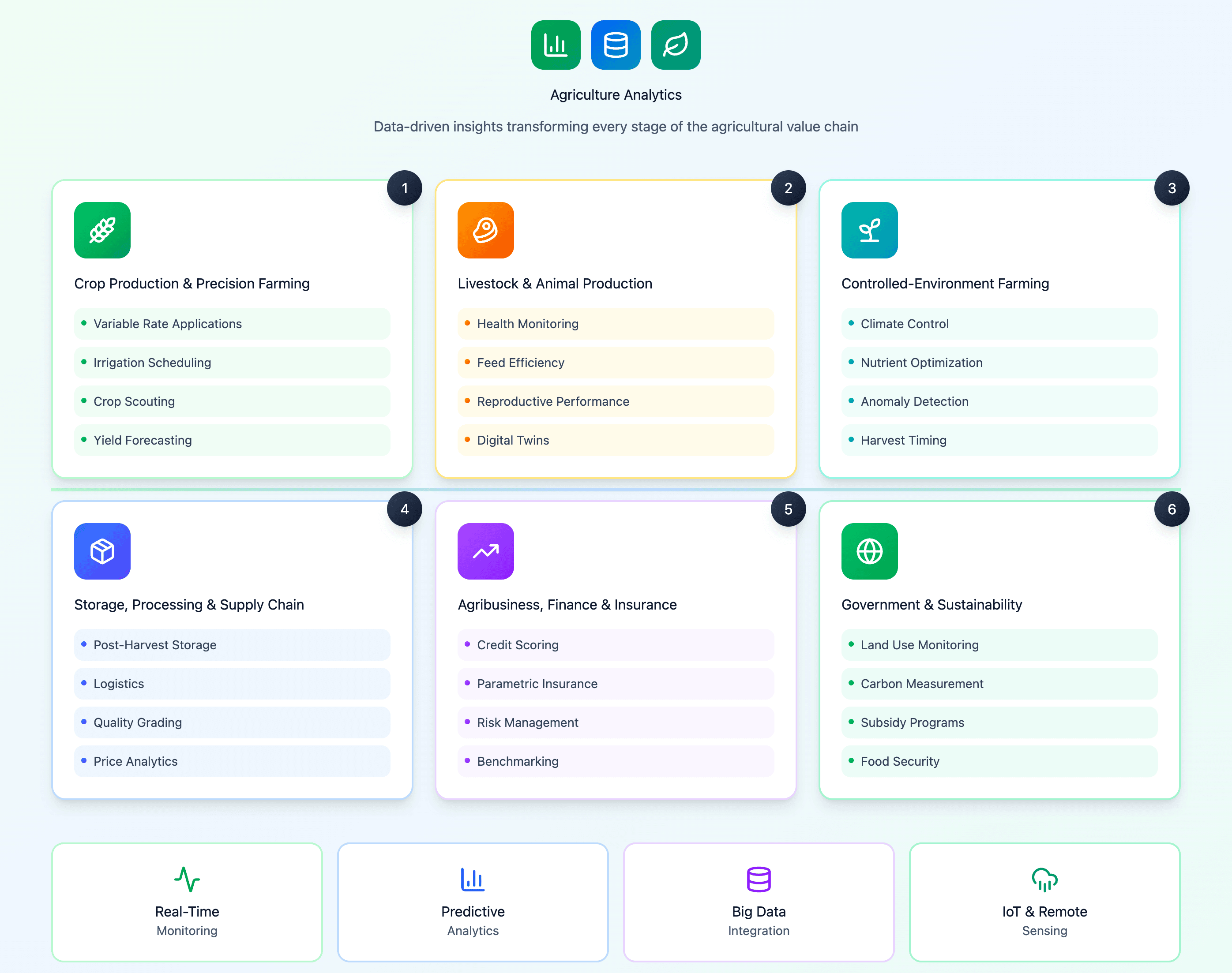
Agriculture analytics: what it is and how it’s used across the value chain
Agriculture analytics is the use of data, statistical methods, and digital tools to turn raw farm and agricultural data into insights that support better decisions. It combines agriculture data analytics, big data analytics in agriculture, predictive analytics in agriculture, and business analytics in agriculture to answer practical questions such as:
1. What should I grow, where, and when?
2. How much fertilizer, water, or feed do I really need?
3. Which fields, animals, or assets are underperforming and why?
4. How will weather, pests, or prices affect my bottom line?
In practice, analytics spans multiple niches and stages of the agri-food system.
Analytics in crop production and precision farming
In cropping systems and precision agriculture, analytics in agriculture focuses on field-level decisions:
1. Variable rate applications – using soil and yield maps to optimize fertilizer, lime, and seed rates per zone.
2. Irrigation scheduling – combining soil moisture data, evapotranspiration models, and weather forecasts to decide when and how much to irrigate.
3. Crop scouting and protection – applying geospatial analytics for agriculture (drones, satellite indices) to locate stress, pests, or disease before they spread.
4. Yield forecasting – using historic yield, weather, and management data to predict harvest volumes and plan storage, logistics, and contracts.
This is where data analytics in agriculture delivers quick, measurable ROI: fewer inputs, higher yields, and more consistent crop quality.
Agriculture analytics in livestock and animal production
The global livestock wearables market was valued at USD 1.2 billion in 2024 and is expected to reach USD 4.9 billion by 2033, growing at a CAGR of 16.7%. For livestock and poultry, it helps optimize health, welfare, and productivity:
1. Behavior and health monitoring – wearables and cameras capture activity, rumination, temperature, and location; analytics detects lameness, heat stress, or illness early.
2. Feed efficiency – correlating feed intake with weight gain or milk yield to refine rations and reduce waste.
3. Reproductive performance – analyzing breeding records to improve conception rates and calving/ lambing intervals.
4. Digital twins of herds or barns – modeling performance under different feed, housing, or health strategies.
Here, predictive analytics in agriculture can trigger alerts (e.g., mastitis risk, heat events) before issues become costly or irreversible.
Analytics in storage, processing, and supply chains
Beyond the farm gate, data analytics in the agriculture industry supports:
1. Post-harvest storage – monitoring temperature, moisture, and gas composition to prevent spoilage.
2. Logistics optimization – routing trucks, planning shipments, and matching supply to demand based on real-time data.
3. Quality grading and traceability – vision systems and sensors classify grain, fruits, or vegetables while analytics tracks product back to field or barn.
4. Price and risk analytics – modeling price scenarios and hedging strategies for grain, meat, dairy, or specialty crops.
This is where business analytics agriculture intersects with traditional ERP, trading, and risk-management tools.
Analytics for agribusiness, finance, and insurance
Banks, insurers, and agribusiness corporations use agriculture analytics to understand risk and profitability:
1. Credit scoring for farmers – combining farm performance data, remote sensing, and market conditions.
2. Parametric insurance – using big data analytics in agriculture (weather, satellite indices) to trigger payouts automatically.
3. Portfolio risk management – understanding exposure to specific crops, regions, or climate risks.
4. Profitability benchmarking – comparing farms or branches to identify top performers and improvement areas.
These analytics tools underpin new financial products and more inclusive access to credit and insurance.
Agriculture analytics for governments and sustainability programs
Public institutions, NGOs, and carbon projects rely on agriculture analytics for:
1. Monitoring land use, deforestation, and compliance via geospatial data.
2. Measuring soil carbon and emissions for carbon markets and sustainability reporting.
3. Designing subsidy and support programs based on real patterns instead of estimates.
4. Food security and climate adaptation planning through modeling of yields, water availability, and risk hotspots.
Here, geospatial analytics for agriculture and big data for agriculture inform national policies and global climate commitments.
Challenges in collecting and processing analytics in agriculture
While the potential of agriculture analytics is huge, turning raw agricultural data into reliable insights is not trivial. Organizations face a set of recurring challenges.
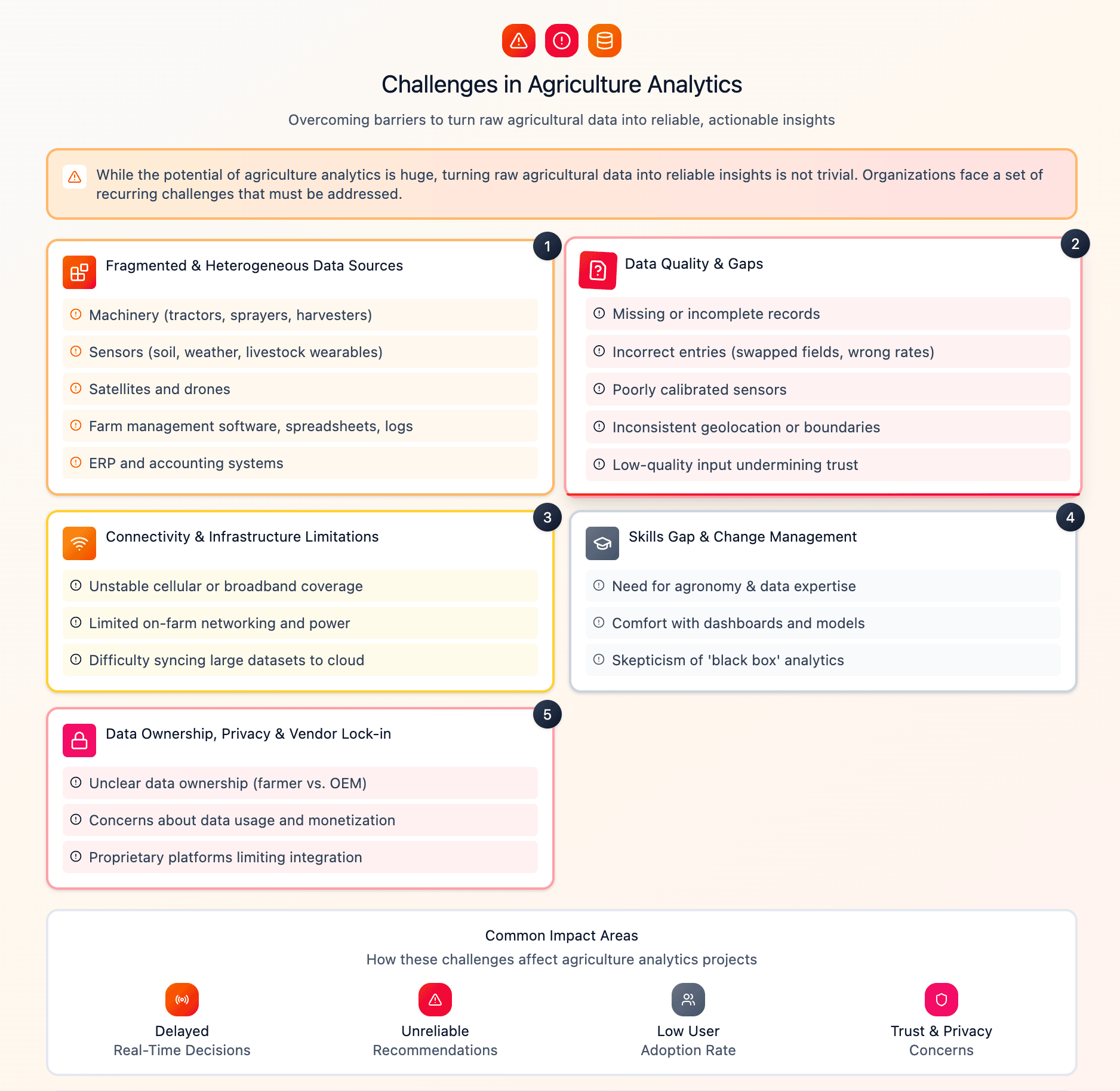
Fragmented and heterogeneous data sources
Data in agriculture comes from many places:
1. Machinery (tractors, sprayers, harvesters)
2. Sensors (soil, weather, livestock wearables)
3. Satellites and drones
4. Farm management software, spreadsheets, paper logs
5. ERP and accounting systems
These systems rarely “speak the same language.” File formats, units, timestamps, and georeferencing can be inconsistent, which complicates agriculture data analytics and slows down analytics projects.
Data quality and gaps
Typical issues include:
1. Missing or incomplete records (e.g., some fields or seasons not recorded).
2. Incorrect entries (e.g., swapped fields, wrong rates, manual typos).
3. Poorly calibrated sensors producing biased readings.
4. Inconsistent geolocation or field boundaries.
5. Low-quality input leads to unreliable analytics in agriculture and undermines trust in any recommendation the system gives.
Connectivity and infrastructure limitations
Many farms, particularly in emerging markets, still struggle with:
1. Unstable cellular or broadband coverage.
2. Limited on-farm networking and power for IoT devices.
3. Difficulty syncing large datasets (e.g., drone imagery, machine logs) to the cloud.
These issues limit the potential of IoT data analytics in agriculture and delay real-time decision-making.
Skills gap and change management
Deploying data analytics for agriculture requires people who:
1. Understand agronomy, livestock, or processing operations.
2. Can work with data, dashboards, and models.
3. Are comfortable acting on digital recommendations.
Many farms and agribusinesses lack in-house data skills, and some operators are skeptical of “black box” analytics. Even good tools can fail if end users are not trained or involved in the design.
Data ownership, privacy, and vendor lock-in
There are ongoing concerns about:
1. Who owns machine and field data: the farmer, OEM, or software provider?
2. How data is used, shared, or monetized.
3. Being locked into proprietary platforms that make it hard to switch or integrate new tools.
These issues slow adoption of agriculture analytics software and can discourage farmers from fully embracing digital tools.
AI solutions for analytics in agriculture
Artificial intelligence is increasingly layered on top of agriculture analytics to move from static reports to real-time, adaptive decision support.
Machine learning for pattern detection and predictions
ML models in agriculture analytics help to:
1. Predict yields, pests, diseases, and equipment failures.
2. Classify crops, weeds, and soil types from images.
3. Segment fields into management zones based on multi-year data.
4. Estimate carbon sequestration and emissions at field level.
These models drive predictive analytics in agriculture and turn historical data into actionable forecasts.
Computer vision
Computer vision adds a rich layer of agriculture data analytics, especially in:
1. Crop scouting – detecting stress, weeds, and nutrient deficiencies from drone or satellite imagery.
2. Sorting and grading – assessing crop quality (color, shape, defects) in processing lines.
3. Livestock tracking – monitoring movement, body condition, and behavior via cameras.
Vision models convert pixels into agronomic metrics that feed dashboards, alerts, and automated control systems.
AI agents and decision support systems
Newer AI + agriculture analytics solutions include:
1. Advisory chatbots and copilots that answer farmer questions using farm data plus agronomic knowledge bases.
2. Recommendation engines that propose optimal irrigation, spraying, or feeding strategies.
3. Autonomous or semi-autonomous systems that apply decisions in the field (e.g., variable rate sprayers, robotic weeders).
Instead of static reports, users get context-aware recommendations that update as data changes.
Integrating AI with existing analytics pipelines
For AI to succeed in agriculture:
1. Data pipelines must be reliable and well structured.
2. Models must be interpretable enough for agronomists and farmers to trust.
3. AI outputs need to be embedded into existing workflows (farm management systems, ERPs, mobile apps).
The most successful implementations treat AI and agriculture analytics as part of the same end-to-end decision system, not as separate experiments.
Want to start using your data right?
Whether you’re managing crops, livestock, controlled-environment farms, or large-scale agribusiness operations, the ability to turn raw data into clear, actionable insights determines how resilient and profitable your business will be in the next decade.
But success in agriculture analytics requires more than tools. It demands the right data pipelines, the right integrations, and the right intelligence behind every decision. That’s where Qaltivate comes in.
At Qaltivate, we help agriculture companies unlock the full value of their data by building AI-ready infrastructure, custom analytics platforms, and decision-support solutions tailored to the realities of the agri-food sector. Our team has hands-on experience working with IoT sensors, geospatial data, livestock monitoring systems, predictive models, digital twins, and cloud-native analytics architectures—everything modern agriculture needs to operate smarter, not harder.
Whether you want to eliminate guesswork in field operations, improve animal health and feed efficiency, streamline your supply chain, or build a fully integrated data ecosystem, Qaltivate can get you there.
Your data already holds the answers.
Let’s turn it into your competitive edge.